
Help
About basement membraneBASE
basement membraneBASE is an open resource for basement membrane research. basement membraneBASE consists of a WordPress site and a database. The WordPress site provides background information on core basement membrane components, major phenotypes in disease, and how different experimental systems can be used to research basement membrane zone components.
Experimental systems page shows how mouse, zebrafish, Drosophila, Caenorhabditis elegans or in vitro based systems can be used to study basement membrane biology. This section focuses on background information, relevant labs that focus on basement membrane research, and key papers in the field.
Major basement membrane components describes the major components of the core basement membrane network and their relevance in disease, specifically providing information on type IV collagen, laminins, heparan-sulphate proteoglycans, type XVIII collagen and nidogens.
Basement membrane database provides information on proteins that can localise to the basement membrane zone. In 2022, a localisation and bioinformatic pipeline identified experimentally validated and predicted components which localise to the basement membrane zone (BMZ) in human, mouse, zebrafish, Drosophila and C. elegans (Jayadev et al., 2022, Science Advances; PMID 35584218). We have compiled data on how these basement membrane zone proteins may interact, their associations with disease, and multiomic and ortholog data, providing an integrated resource of basement membrane zone diseases.
Searching
- Search box: type a gene or protein name, an Entrez or UniProtKB ID, a bmBASE entry ID, a disease or a reagent.
- Searched terms can be filtered by species (human, mouse, zebrafish, Drosophila and C. elegans), matrisome protein classification, or protein localisation evidence (antibody staining, endogenous tagging, protease activity, verified or predicted interactions).
Evidence labels
Small labels appear next to each gene to show the evidence for basement membrane zone localisation.
| Label | Meaning |
|---|---|
| Ab | Antibody evidence for localisation to the basement membrane zone in that species. |
| Tag | Localisation shown by endogenous labelling of the gene in that species, or of an ortholog. |
| Enz | Basement membrane protease activity. |
| Int | Basement membrane interactions. |
| Pred | Predicted basement membrane component, determined through predicted interaction with a confirmed basement membrane component, ECM domain analysis and a secretion signal. |
The gene page
Each gene page has compiled data to help understand the component and its potential role in the basement membrane zone.
- Gene & Protein: name, gene size, protein molecular weight (kD), protein domains and protein classification, alongside Entrez and UniProtKB external references.
- Protein Localisation: published localisation evidence, with the reagents used and localisation images.
- Interactions: basement membrane ligands shown as protein-protein interaction networks and, for proteases, basement membrane substrates shown as protease cleavage networks. Ligands and substrates listed next to the images link to their basement membrane zone gene page.
- Associated Diseases: links to disease databases representing human pathology.
- Multiomics: links to external databases with proteomic evidence in the extracellular matrix.
- Orthology: identified orthologs, with links to the ortholog gene pages in basement membraneBASE.
- See also: links to the gene in other databases.
Reading the interaction networks
Each network shows one protein in the centre, with its basement membrane zone interaction partners around it.
- Pink nodes are basement membrane components. Green nodes are cell-surface receptors.
- Solid lines show interactions with experimental evidence in STRING. A partner with a higher STRING experimental score sits closer to the centre.
- Grey dashed lines show predicted interactions, with no experimental score. These partners sit on the outer rings, and their position carries no information.
- In the protease cleavage networks, red dashed lines show a protease cleaving a substrate.
- Interactions come from STRING and MatrixDB. Protease substrates come from BRENDA. STRING scores come from the organism-specific STRING data for each species.
- Click Open full size to see a network at full resolution.
Example: MMP7
MMP7 (matrilysin) is a basement membrane protease, so its gene page has both network types.
Protein-protein interaction network (ligands)
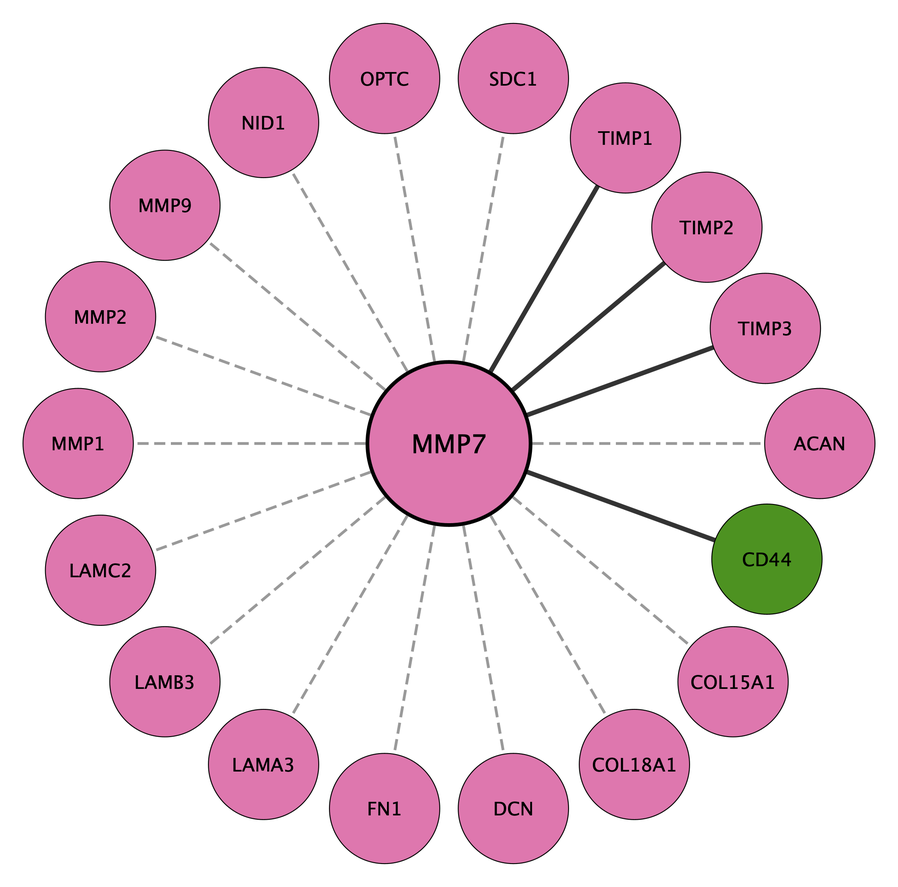
- MMP7 is the protein in the centre. Its partners sit around it.
- Solid lines go to partners with an experimental score in STRING (CD44, TIMP1, TIMP2 and TIMP3). The higher the score, the closer the partner sits to the centre.
- Grey dashed lines go to partners with no experimental score. They sit on the outer ring, and their position carries no information.
- Green nodes are cell-surface receptors (here CD44). Pink nodes are basement membrane components.
Protease substrate network (cleavage)
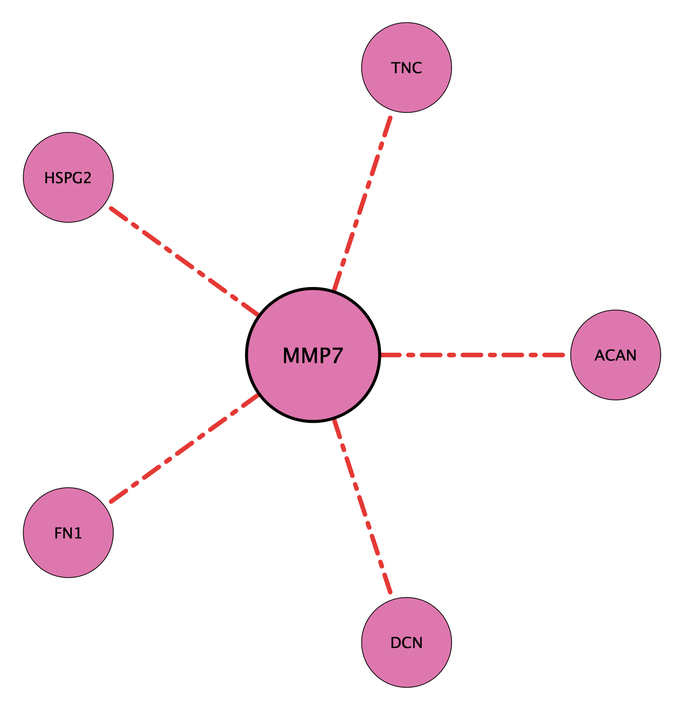
- MMP7 is in the centre. Red dashed lines go to the basement membrane proteins it cleaves: ACAN, DCN, FN1, HSPG2 and TNC (substrates from BRENDA).
- A protein can appear in both networks. For MMP7, ACAN, DCN and FN1 are listed as ligands and as substrates, because binding and cleavage are different relationships with different evidence.
Contact
Questions about basement membraneBASE? Get in touch.